Framing is the “skeleton” of a home. It gives shape to the floors, walls, and roof. When people start a build, one of the first questions is what type of wood is used in framing a house. This guide explains the choices in plain language so you can make smart decisions. We’ll look at framing wood types, how lumber is graded, and what sizes work where. You’ll also learn which species are common, why builders prefer them, and how to read the stamps on boards. By the end, home framing will feel clear, not confusing. You’ll know which framing lumber helps you get a strong, straight, and long-lasting frame.
Framing house construction usually starts with a plan, a framing material list, and a schedule. The builder checks spans, loads, and codes. Then they pick construction lumber that matches the design. The lumber forms a wooden frame of a house: studs, plates, joists, rafters, and beams. Each piece has a job. Studs stand vertical in the walls. Plates run along the top and bottom of the studs. Joists support floors and ceilings. Rafters shape the roof. Beams carry heavy loads. Together, they create a safe structure.
Why Builders Choose Wood: Strength, Cost, and Speed
Wood remains the top choice for new construction framing for good reasons. It is strong for its weight, easy to cut, and fast to assemble. Carpenters can frame a house with a small crew and simple tools. That keeps labor costs down. Wood is also a renewable resource when forests are managed well. For most homes, wood delivers a great balance of strength, price, and performance.
Compared to steel or concrete, wood installs faster for typical houses. It also provides natural insulation. That helps with comfort and energy bills. You can nail, screw, or glue wood with everyday tools. Repairs are straightforward too. If a stud bows or splits, a framer can replace it without special equipment.
At FONZ Construction, we also value wood because supply lines are steady. Common species are widely stocked. That means fewer delays and better pricing for clients. With smart choices, you can get the best wood for building houses without breaking the budget. We’ll cover these “smart choices” next: species, grades, and sizes that work for walls, floors, and roofs.
What Type of Wood Is Used in Framing a House?
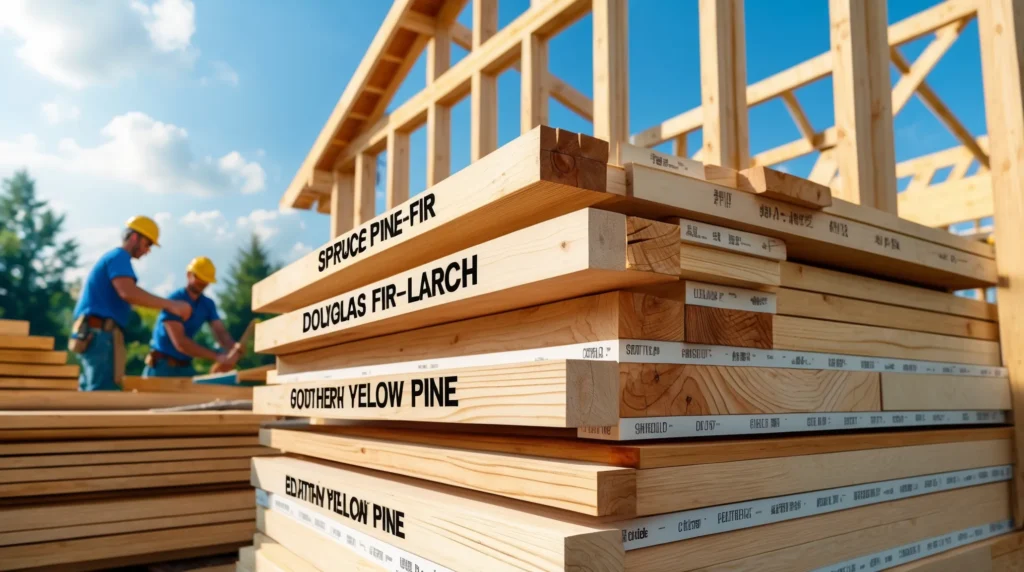
In most areas, framers use softwood species. The most common groups are:
- SPF (Spruce-Pine-Fir): This is a mix of closely related species. SPF is light, easy to cut, and widely available. It’s popular for studs, plates, and many parts of the frame.
- Douglas Fir–Larch (often stamped DF-L): Known for good strength and stiffness. Many builders like it for joists, rafters, and beams.
- Southern Yellow Pine (SYP): Strong and dense. It holds nails well and is common in many regions, especially in the southeast U.S.
All three can be great framing wood when chosen in the right grade. They are the types of wood used for construction that balance cost and performance. When you ask “what type of wood is used for framing,” these species usually lead the list. For lumber for house framing, availability by region matters. In some places, SPF dominates. In others, Douglas Fir or Southern Pine is easier to find and may be priced better.
Framing Lumber Basics: Grades, Stamps, and Moisture
When you pick framing boards, look for the grade stamp. Common grades for house framing lumber are “#2” and “Stud.” A #2 grade allows some knots and wane (a bit of bark edge), but the board must still meet strength rules. “Stud grade” is designed for vertical use in walls. It focuses on straightness and stiffness for that job. Higher grades (#1, Select Structural, or MSR machine stress rated) give even better strength and consistency, but often at higher cost.
The stamp also shows moisture content. “KD” means kiln-dried. “S-Dry” or “KD-19” usually means the board was dried to around 19% moisture content or less. Drier lumber shrinks and twists less after installation. For indoor framing, kiln-dried lumber is the norm. Avoid overly wet boards for interior walls; they can cup, bow, or split as they dry in place.
You may also see species groups (SPF, DF-L, SYP) and mill numbers on the stamp. This helps you verify quality and trace the source. If you wonder “what is framing lumber,” think of it as structural wood that meets rules set by grading agencies. Those rules tell you the board’s expected strength and how it should be used. Good practice is to sight each board (look down its length) and set aside any warped pieces. Even the best framing lumber pile will have a few boards that don’t make the cut for visible or load-critical spots.
Most Common Wood Used in Construction: SPF, Douglas Fir, Southern Pine
What is the most common wood used in construction?” It depends on where you live. Across many regions, SPF is the go-to choice. It is light, workable, and a budget-friendly type of lumber for framing. In areas with easy access to Douglas Fir, builders favor DF-L for joists and rafters because it resists bending (deflection) better at a given size and spacing. In places where Southern Yellow Pine is abundant, SYP is a top option, especially for floor systems that need high strength.
Each group has pros:
- SPF: Often the best lumber for framing walls and plates; easy to nail, good availability, and usually the best value.
- DF-L: Excellent for long spans; often chosen for roof rafters, headers, and beams.
- SYP: Strong and dense; great for floors, decks, and situations where screw holding power matters.
The most common wood used in construction is selected by cost, supply, and performance. Your builder picks from these families to match your plan. If you aim for the best wood for building, focus on both species and grade. A #2 DF-L 2×10 may carry more load than a #2 SPF 2×10 at the same spacing. But a #1 SPF board can beat a #2 DF-L board in some cases. That’s why grade and span tables matter as much as species.
What Type of Wood Is Used for Framing Walls and Interior Partitions?
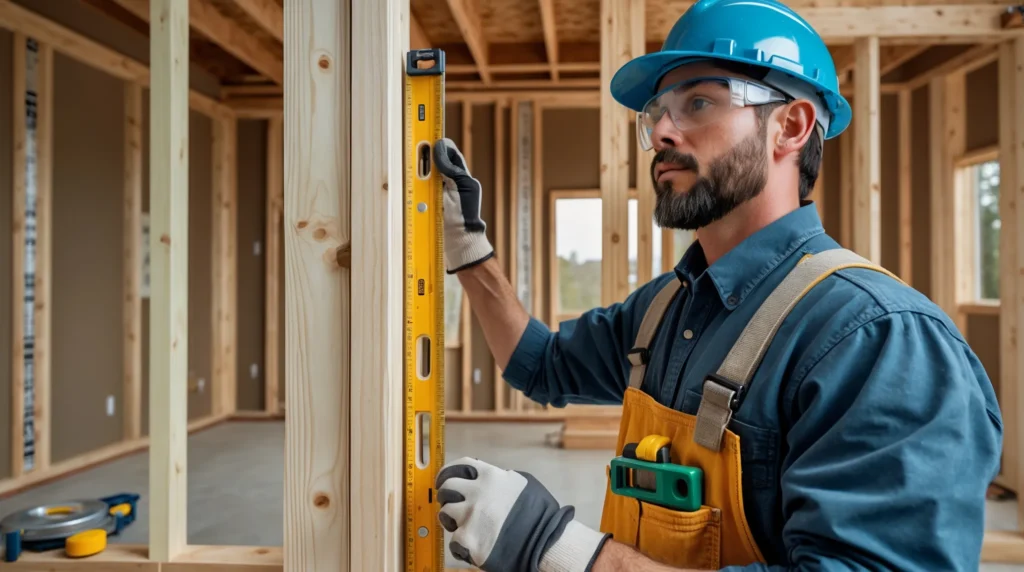
For interior walls, the staple is 2×4 framing wood. Many homes also use 2×6 studs for exterior walls to fit thicker insulation or support taller walls. The “best 2×4 for framing” is typically a straight, kiln-dried #2 or Stud grade in SPF, DF-L, or SYP. Look for clean edges, minimal twist, and tight, small knots. Sight each piece and pick the straightest ones for doorways and other visible or critical areas.
So, what type of wood is used for framing walls? Builders often use SPF #2 or Stud grade because it’s easy to work with and cost-effective. DF-L Studs are also common, especially when extra stiffness is desired. For moist areas, like basements or bottom plates on slabs, a pressure-treated bottom plate can protect against rot. Above that, regular kiln-dried studs are fine. This approach balances cost and durability.
“What size wood is used for framing walls?” For most rooms, 2x4s at 16 inches on center is standard. For taller walls or higher loads, 2x6s or closer spacing may be used. In simple terms, indoor framing uses straight, dry studs that match the plan. If you’re unsure, ask the builder which type of framing is most commonly used in housing in your area. In many places, platform framing with 2×4 or 2×6 studs is the norm.
Best Wood for Framing: Choosing the Right 2×4 and Grade
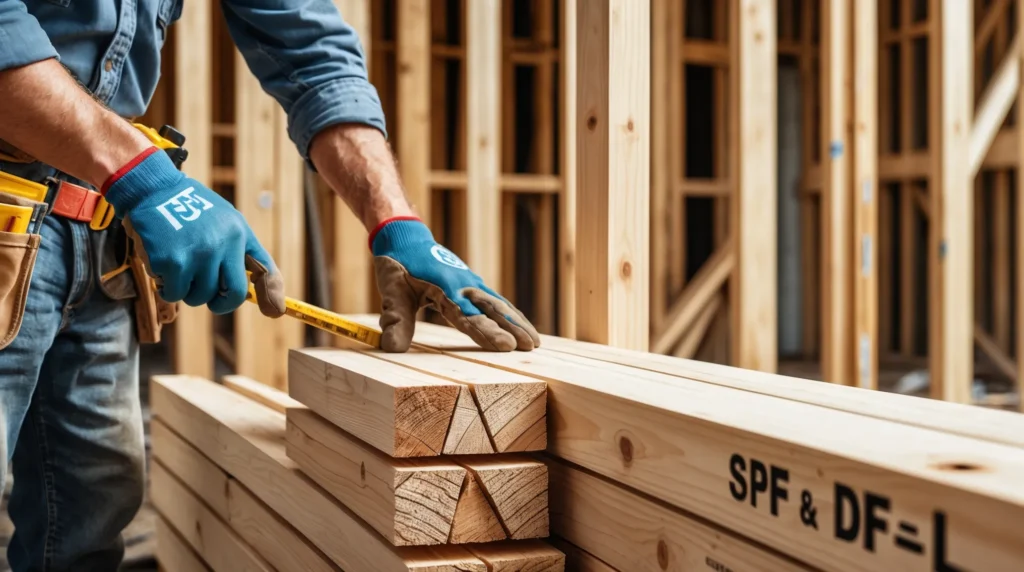
When people ask for the best wood for framing, they often want the “straightest stud at the best price.” Here’s a quick way to choose:
- Use kiln-dried studs for interior walls. KD lumber stays straighter.
- Pick Stud or #2 grade for most walls; consider #1 or MSR for critical spans.
- Sight every board. Place the “crown” (slight curve) up for joists and consistent for studs.
- Avoid large loose knots, splits, and severe twist.
- Keep boards stored flat, off the ground, and covered from rain.
“Best wood for house framing” can be SPF, DF-L, or SYP. The “best framing lumber” is the one that meets code, stays straight, and fits your budget. For example, the best 2×4 for framing may be a Stud-grade SPF stick with few knots and a crisp, square edge. But for a long header over a wide opening, a DF-L LVL beam might be the best building wood because it resists bending far better than regular boards.
Some homeowners ask, “What is the best wood to build a house with?” There is no single winner. Instead, think “best for the job.” SPF or DF-L studs for interior walls, DF-L or SYP for long-span joists, and engineered wood for big openings. That mix gives you the best wood for building houses without overpaying where you don’t need to.
Types of Framing Lumber: Studs, Plates, Joists, Rafters, Beams
Let’s map the main pieces, so you can read a framing material list with confidence:
- Studs: The vertical boards in a wall. Commonly 2×4 or 2×6. “Stud grade” boards are picked for this job.
- Plates: The bottom and top horizontal boards in a wall. Bottom plates can be pressure-treated on slabs; top plates tie the studs together.
- Headers: Short beams over doors and windows. Often doubled 2x boards or engineered lumber for wider spans.
- Joists: Horizontal boards that support floors and ceilings. Spacing and size depend on span and load.
- Rafters: Sloped boards that form the roof. They carry weight from roofing and snow/wind loads.
- Beams/Girders: Larger members that carry heavy loads. Often engineered wood (LVL, PSL) or built-up lumber.
These are the wooden framing materials that make the frame building structure. They come in standard wood framing dimensions—2×4, 2×6, 2×8, 2×10, 2×12—and longer lengths for joists and rafters. The types of lumber used in construction also include sheathing (plywood or OSB) for walls, floors, and roofs. Sheathing ties everything together, making the frame strong as a system.
Are Studs Hard or Softwood? What That Means for Strength
Studs are almost always softwood. That includes SPF, DF-L, and SYP. Softwood does not mean weak. It simply refers to tree type. Many softwood species make excellent structural members. They are strong for their weight, hold fasteners well, and dry predictably. Hardwood studs (like oak or maple) are not used in typical house framing because they are heavy, expensive, and harder to work.
So, when you ask “are studs hard or softwood,” the answer is softwood. That’s true for most wall studs, plates, and many joists and rafters. For high-load parts, builders sometimes use engineered wood (LVL, PSL, or glulam). These are made by gluing thin layers or strands together to create a very strong member. They’re not “hardwood,” but they offer high strength and stability where needed, such as wide openings or long spans.
Why does this matter? When choosing type of wood used in construction, you want the right mix. Use common softwood studs for walls. Use stronger species or engineered pieces for beams and long spans. This approach keeps costs down while meeting code. It also makes repairs and future changes easier, since standard softwood framing is familiar to every carpenter.
Hillsboro Homeowners: Sourcing House Framing Lumber with FONZ Construction
Buying lumber can feel tricky, but a few simple steps help. First, read the grade stamps. Look for SPF, DF-L, or SYP and a grade like #2 or Stud. For longer spans, ask about higher grades or engineered wood. Second, check moisture. Kiln-dried (KD) or S-Dry lumber is best for interior studs and plates. Avoid very wet boards inside; they can twist later. Third, sight each board. Set aside badly bowed or twisted sticks. Use the straightest pieces for door and window areas.
Fourth, match the board to the job. For a header over a wide door, an LVL might be better than two regular 2x10s. For a short interior wall, standard SPF Studs are perfect. Fifth, handle and store lumber wisely. Keep it off the ground, covered from rain, and supported flat. Good storage keeps boards straight before they go into your home. Sixth, use a clear framing material list. List studs, plates, headers, joists, rafters, and sheathing by size and count. This keeps ordering accurate and avoids multiple trips.
Finally, communicate with your builder. Ask about types of wood used to build houses in your region and why they prefer them. Some crews like SPF because it cuts fast and keeps lines crisp. Others love DF-L for long joists and rafters. Your plan, budget, and local supply all play a role. If you want a second opinion, bring a sample board and the stamp to your builder. They can confirm if it fits the job.
FONZ Construction can walk you through these choices, explain grade stamps, and help you balance cost and performance. With a clear plan and the right mix of studs, plates, joists, rafters, beams, and sheathing, you’ll get a frame that is strong, quiet, and ready for a beautiful finish.
Ready to move from plan to build? Tell us your timeline, and we’ll help you choose the right framing lumber for a smooth, stress-free start.